
The End of Advice Scarcity
A Note Before We Begin
Agora was built on a single belief: that every Canadian investor deserves a real financial advisor — a trusted professional who shows up with judgment, context, and genuine care. A human professional with the time, the tools, and the data to actually know them. Until now, the economics made that impossible for most households. Orbit changes the economics. It is an operating system natively built around AI — not a platform with AI added to it, but one where intelligence is structurally embedded in the data layer, the advisor workflow, the compliance layer, the user interface, and the client relationship. We built it from the ground up to do one thing: make advice scalable.
That conviction did not emerge from a market analysis or a strategy deck. It came from looking at the reality of who gets quality financial advice in Canada — and who does not. Approximately 4.5 to 5 million Canadian households hold an estimated $2.4 trillion in investable assets in the mass affluent segment. The overwhelming majority are either unadvised or receiving something that falls well short of genuine guidance. They are not being failed because they lack the desire for advice, or because their finances are too simple to warrant it. They are being failed because the industry model was built for someone else.
4.5 million Canadian households. $2.4 trillion in investable assets. The largest underserved market in Canadian wealth management has been hiding in plain sight.
The research is unambiguous about what that failure costs ordinary Canadians. Households that work with a financial advisor accumulate between 2.3 and 3.9 times more assets over fifteen years than comparable households without one — they build plans, enforce savings discipline, protect against reactive decisions, and provide the sustained accountability that turns financial intention into financial reality. Advice is not a luxury service for the wealthy. It is one of the most consequential financial resources available to an ordinary household — and millions of Canadians do not have access to it.
That is the problem Agora was built to solve. And this paper is our case for why the moment to solve it has finally arrived.
With the launch of Orbit — Agora’s advisor operating system — the infrastructure to deliver scalable, personalized, human-led advice to the mass affluent is no longer theoretical. It is about to go live. For the first time, an advisor can serve the $25,000 household and the $750,000 household with the same quality of attention, the same depth of planning, and the same consistency of care — because the platform handles everything the platform should handle, and reserves the advisor’s judgment for what judgment is actually for.
The first fintech era made investing accessible. The next era will make advice abundant. We are here to lead that.
This paper is written for everyone with a stake in that outcome — investors evaluating the opportunity, advisors considering what the next decade of their practice looks like, dealers and platforms thinking about where the industry is heading, and regulators navigating how to expand access without compromising protection. It makes the market case, examines the evidence, confronts the narratives that have misled ordinary investors, and addresses the execution challenges that will determine which firms define this era.
The argument is straightforward. The opportunity is real. The window is open. And Agora is already building through it.
Executive Summary
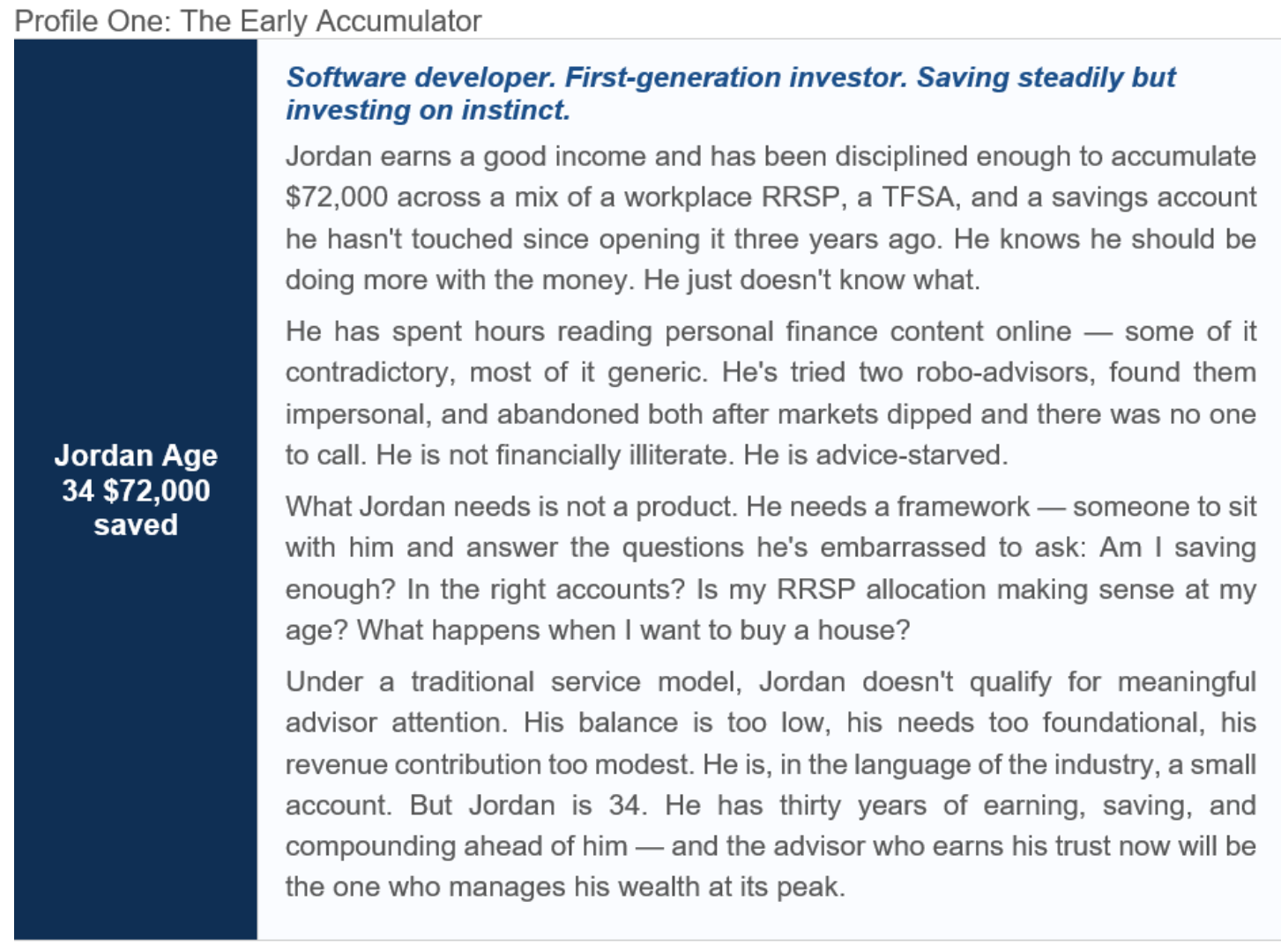
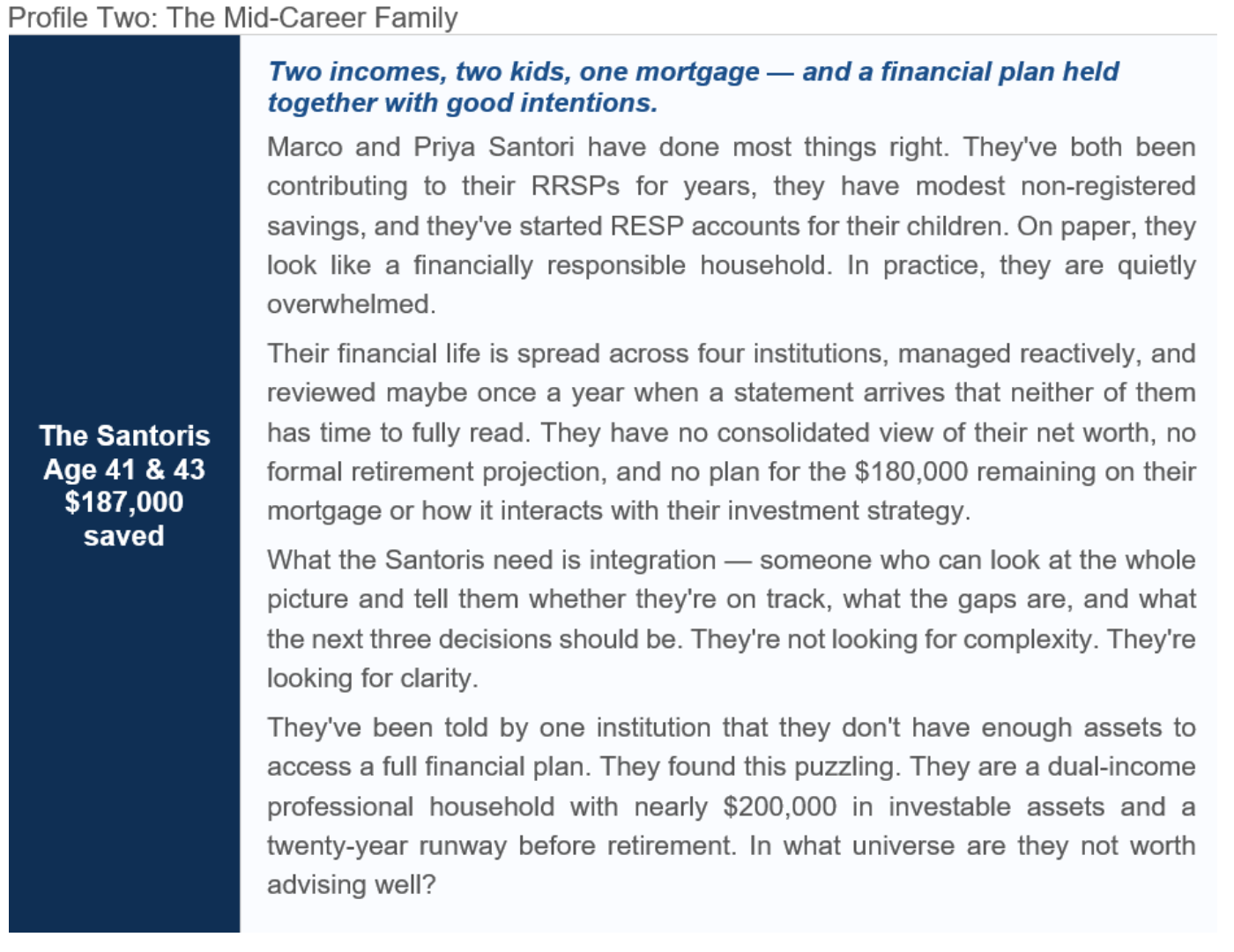
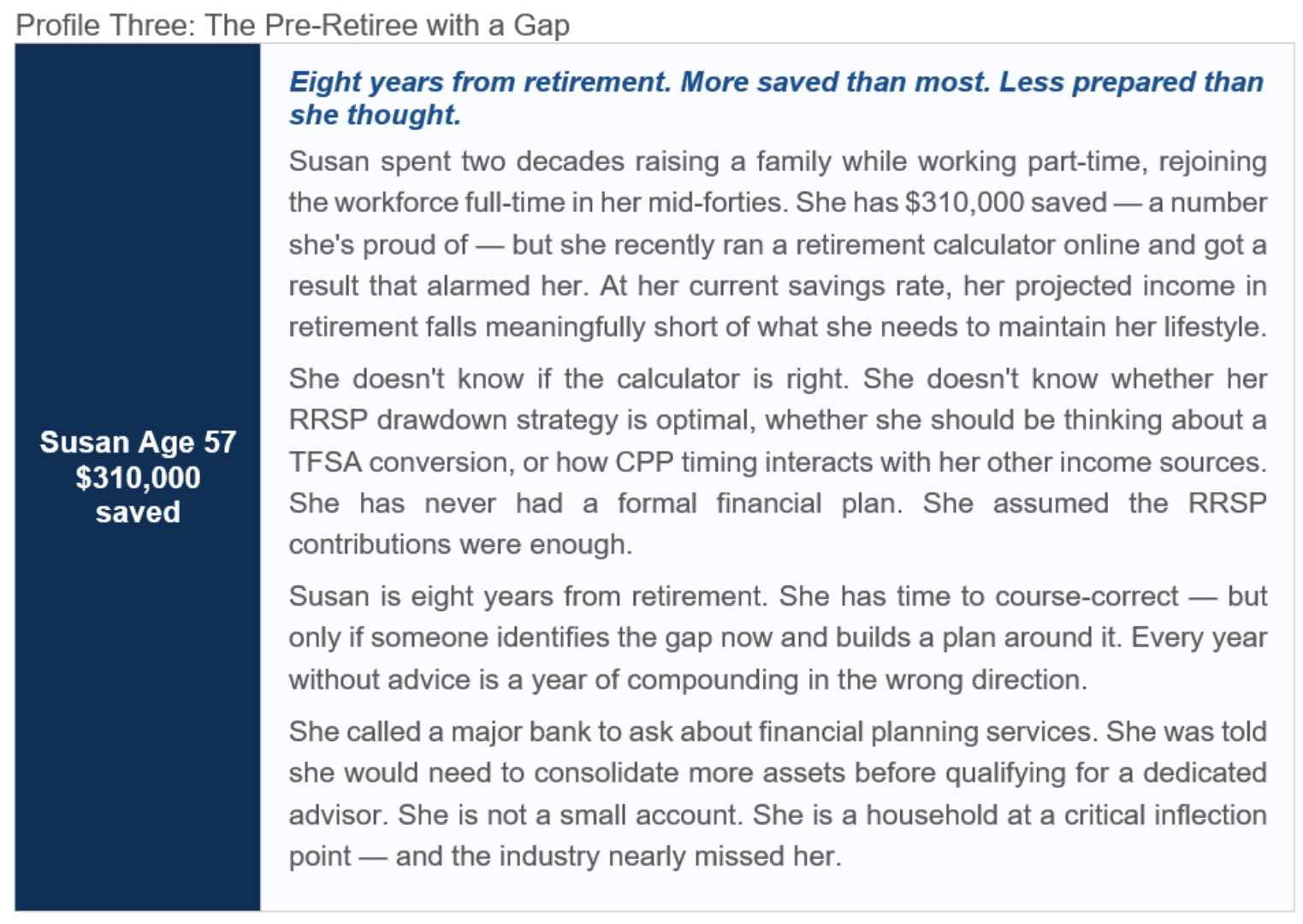
The Canadian mass affluent — households with between $25,000 and $500,000 in investable assets — represent one of the largest underserved markets in modern wealth management. According to Statistics Canada’s Survey of Financial Security, approximately 4.5 to 5 million Canadian households fall within this segment, collectively holding an estimated $2.4 trillion in investable assets. That is the mainstream — and the majority of it is either unadvised or underserved by the current model. They are Jordan, the 34-year-old software developer saving steadily with no plan. The Santoris, a dual-income professional family with $187,000 spread across four institutions and no consolidated picture of their financial life. Susan, eight years from retirement with a gap in her plan she doesn’t know is there. They are real, they are everywhere, and they have been failed — not because the industry didn’t care, but because the industry couldn’t afford to serve them well.
That is changing.
For decades, the challenge was never whether modest investors deserved advice. It was whether the industry could afford to deliver it. Now a natively AI-integrated operating system changes that equation.
The evidence that advice matters is unambiguous. Research by Montmarquette and Viennot-Briot for CIRANO (commissioned by IQPF and FP Canada) found that households working with financial advisors accumulated between 2.3 and 3.9 times more assets over fifteen-year periods than comparable non-advised investors — a gap driven not by investment selection alone, but by savings discipline, diversification, behavioural coaching, and the sustained accountability of a genuine planning relationship. Advice is not a luxury. For ordinary households, it is among the most financially consequential resources available.
Two structural forces have shaped the advice gap — and understanding both is essential to closing it. The first is an incumbent industry model that concentrates quality service on high-balance clients and routes everyone else to call centres, product shelves, and reactive service that falls well short of genuine advice. The second is the self-directed investing narrative — the claim that skipping an advisor and keeping the 1% fee is the path to greater wealth. That claim rests on four hidden assumptions, all of which the research contradicts, and it has misled a generation of ordinary investors away from guidance that would have meaningfully improved their outcomes.
An operating system natively built around AI dissolves both obstacles simultaneously. When intelligence is structurally embedded in the data architecture, the compliance layer, the advisor workflow, the user interface, and the client relationship — not bolted on, but built in from the ground up — one advisor can serve the $75,000 client and the $750,000 client with equal quality of attention. The unit economics of advice delivery change fundamentally. The mass affluent become not just worth serving, but among the most compelling growth opportunities in the industry.
This paper makes that case in full. It examines the evidence for advice, the human cost of its absence, the flawed narratives that have filled the gap, the technology that now changes the conditions, and — critically — the management execution capability required to actually build at the speed this moment demands. Because the opportunity is real, the window is open, and the firms that move with clarity and conviction now will be the ones that define what wealth management looks like for the next generation of ordinary Canadians.
The future is human advice, delivered at scale through an operating system built to make it possible.
I. The Scarcity Problem: How Advice Became a Premium Good
The concentration of quality financial advice among high-net-worth households was a product of specific economic conditions — conditions that defined the industry for decades but no longer need to define its future.
Ordinary investors have long needed help with the full spectrum of financial life: retirement readiness, investing discipline, tax efficiency, major life transitions, risk management, and emotional decision-making during market volatility. These needs do not diminish because an investor holds fewer assets. If anything, the consequences of poor financial decisions are more acutely felt by those with less margin for error.
The traditional economics of advice created a persistent mismatch between need and service. Advisor time is expensive. Onboarding is manual. Software systems are fragmented. Compliance burdens are high. And perhaps most damaging of all — service models wait for the client to call.
In a reactive model, the advisor responds to whatever the client brings to them. The problem is that most clients don’t call when they should. Jordan doesn’t call because he doesn’t know what questions to ask. The Santoris don’t call because they’re busy and assume no news is good news. Susan doesn’t call because she doesn’t yet know her plan has a gap. The households that most need proactive guidance are precisely the ones least likely to reach out for it.
The result is advice that is available in theory and often absent in practice — present when the client initiates, invisible when they don’t. In this environment, the rational commercial response was to concentrate resources on the highest-balance clients: the ones who called, who asked, who knew what they needed. Households with $25,000 to $250,000 in assets were left to manage on their own — not because their needs were smaller, but because the model was never built to find them.
The result was a market defined not by the absence of demand — but by the structural inability to meet it profitably.
That distinction matters enormously, because it means the path forward is not a new class of clients. It is a new operating model. And the scale of what is at stake makes the case for urgency clear: approximately 4.5 to 5 million Canadian households holding an estimated $2.4 trillion in investable assets — the mass affluent segment — are living that gap right now.
II. The Myth of the Small Account
The wealth management industry has long operated under a flawed assumption: that accounts below a certain threshold — often cited as $100,000 or in some cases $250,00 — are simply not worth serving. This belief became embedded in service models, compensation structures, and technology investment decisions, shaping an entire generation of advisor practice management.
The $100,000 household was not too small. Traditional systems were too expensive.
Canada’s own experience challenges the premise directly. The MFDA channel alone serves approximately 9.2 million client accounts — the advisors and households that represent Agora’s core market. The majority of those accounts fall below the $100,000 threshold. Across approximately 4.5 million Canadian households in the mass affluent segment, these are not fringe clients. They are the mainstream market — the foundational base of the industry’s client relationships. To treat them as too small to serve well is to misread the very nature of the business.
Beyond the immediate balance, the case for serving the mass affluent is compelled by a dynamic view of lifetime value. Today’s $100,000 household may be tomorrow’s $500,000 investor following an inheritance, a promotion, or the sale of a business. It may represent a family with multiple members, a referral network, or a decades-long planning relationship that compounds in value over time. Wealth firms that optimized purely for current balances systematically underprice the long-term relationships they are declining to build.
Smaller accounts were never fringe. They were the mainstream market — and firms mistook current balances for lifetime value.
Recognizing this is both a strategic insight and a business imperative for firms seeking sustainable growth in an environment where high-net-worth client acquisition is intensely competitive and increasingly expensive.
III. The Evidence for Advice
Before addressing how a natively AI-integrated operating system changes the economics of advice delivery, it is worth pausing on a foundational question: does advice actually create value for clients? The answer, based on a growing body of research, is unambiguous.
Advised households consistently outperform their unadvised counterparts across multiple dimensions of financial health. They save at higher rates. They maintain more diversified portfolios. They invest more consistently across market cycles. They are less likely to panic-sell during periods of volatility. And they engage in more deliberate long-term planning behaviour.
The cumulative effect is substantial. Research by Claude Montmarquette and Nathalie Viennot-Briot for CIRANO — commissioned by IQPF and FP Canada and examining thousands of Canadian households across multiple survey waves — found that advised investors accumulated between 2.3 and 3.9 times more assets over fifteen-year periods than comparable non-advised investors, after controlling for income, age, education, and risk tolerance. This is not a measure of investment selection alone — it reflects the full value of guidance, accountability, and behavioural coaching delivered across a sustained relationship.
The independent evidence reinforces this from two additional directions.
Vanguard’s Advisor Alpha framework — published by the world’s largest passive fund manager, an institution with no commercial incentive to overstate the value of active advice — estimates that a well-run advisory relationship adds approximately 3% net per year in value above what investors achieve on their own. Critically, the single largest component of that value is not investment selection or tax efficiency. It is behavioural coaching — the guidance that keeps investors disciplined through volatility, consistent through uncertainty, and focused on the long term when short-term noise makes that genuinely difficult. Vanguard estimates behavioural coaching alone accounts for approximately 1.5% of that annual value-add. In many cases, that figure exceeds the advisory fee itself.
Morningstar’s Mind the Gap study provides the mirror image of that finding — not what advisors add, but what their absence costs. By measuring the gap between the returns funds earn and the returns investors in those funds actually receive, Morningstar isolates the pure cost of investor behaviour: the panic selling, the performance chasing, the mistimed entries and exits that erode compounding year after year. Over the ten-year period ending 2023, that gap averaged approximately one percentage point per year — a sustained, recurring drag on wealth accumulation driven entirely by decisions investors made, or failed to make, at the wrong moments. Morningstar notes this is likely a conservative estimate.
Together, these findings frame the evidence precisely. Advice is worth approximately 3% per year in added value. Going without it costs approximately 1% per year in behavioural drag — and often more in the moments that matter most. The question has never really been whether advice creates value. It is why so few ordinary households have had access to it.
Canada’s experience proved that average investors benefit from advice. Orbit is built to prove they can receive it at scale.
This evidence does not imply that every advisor relationship is equally valuable, or that advice is uniformly delivered to a consistent standard. Quality varies. Conflicts of interest exist. The regulatory framework continues to evolve. But the underlying proposition — that sustained, personalized guidance improves financial outcomes for ordinary investors — is well-supported and difficult to dispute.
The implication is direct: if advice works, and if millions of households currently lack access to quality advice, then expanding that access is among the highest-impact interventions available to the industry. The question is how to do so profitably and at scale.
IV. The Human Cost of Advice Scarcity: Voices from the Wealth Journey
Behind every data point about the mass affluent market is a household — a family making decisions about their financial future, often without the guidance that could make the difference between a comfortable retirement and a precarious one. The following profiles are composites drawn from the lived experience of ordinary Canadian households. They are not edge cases. They are the mainstream.
What These Households Have in Common
Jordan, the Santoris, and Susan are not outliers. They represent tens of millions of households across Canada and similar markets — people who have made responsible financial decisions, accumulated meaningful assets, and still find themselves without access to the quality guidance that could materially change their outcomes.
None of them lack the desire for advice. None of them lack the assets to justify it in any reasonable long-term calculation. What they lack is a delivery model capable of reaching them profitably.
The advice gap is not a story about investor apathy. It is a story about industry architecture.
An operating system natively built around AI changes the underlying economics that created this gap. When the cost of serving a $72,000 account approaches the cost of serving a $720,000 account — not in advisor time, but in platform capability — the rationale for exclusion collapses. Jordan, the Santoris, and Susan don’t need to be wealthy to deserve a financial plan. They need an industry that has finally built the infrastructure to reach them.
The mass affluent were never too small to matter. The industry was simply too expensive to serve them — until now.
V. A Note on the DIY Narrative
The rise of self-directed investing was not accidental. It filled a vacuum.
When quality financial advice was unavailable to ordinary households — when the industry’s answer to a $75,000 account was a call centre or a product shelf — self-directed platforms offered something that felt like an alternative. And the narrative they built around it was seductive: eliminate the advisor fee, invest yourself, and retire wealthier.
That claim rests on assumptions the research consistently contradicts. Advised households save at higher rates, invest more consistently, and make fewer of the behavioural mistakes that erode long-term returns. Morningstar’s Mind the Gap study found a persistent gap of approximately one percentage point per year between what funds earn and what self-directed investors in those funds actually receive — driven entirely by the timing of their own decisions. Montmarquette found advised households accumulate between 2.3 and 3.9 times more assets over fifteen years. Vanguard estimates advisor value-add at approximately 3% annually, with behavioural coaching as the single largest component.
The DIY narrative had power not because the evidence supported it. It had power because the alternative — genuine, accessible, human-led advice — was not on offer for most ordinary Canadians.
That is what this paper is about changing.
When advice is genuinely accessible — personalized, proactive, and delivered by a real professional who knows the client’s full picture — the self-directed comparison loses its premise. The question ordinary investors have always deserved to be asked is not whether they can manage alone. It is whether they should have to.
The Behavioural Gap Is the Biggest Variable
Markets do not move in straight lines. They crash, recover, stall, surge, and confound even professional investors. The question is not whether a self-directed investor experiences these events. It is what they do when they do.
Research on investor behaviour consistently finds that individual investors systematically underperform the very funds they invest in — because they buy after gains and sell after losses, doing the opposite of what a long-term compounding strategy requires. Morningstar’s annual Mind the Gap study — which measures the gap between the returns funds earn and the returns investors in those funds actually receive — found that over the ten-year period ending 2023, the average investor earned approximately 6.3% annually versus 7.3% for the average fund. A gap of one percentage point per year, sustained over a decade, purely from the timing of investor decisions. Morningstar notes this is likely a conservative estimate, as it excludes the impact of investors abandoning funds entirely during downturns.
An advisor’s most valuable contribution is often not investment selection. It is the phone call that talks a client out of selling everything in March 2020.
This is the value that no fee comparison spreadsheet captures. The cost of panic selling a diversified portfolio in a downturn — and missing the recovery — can exceed years of advisory fees in a single decision. The advisor who prevents that decision has more than paid for themselves. The DIY investor who makes it has done the opposite of retiring richer.
What the Research Actually Shows
The Canadian evidence on advised versus non-advised investors is among the most comprehensive available anywhere. The Montmarquette/IQPF research examined thousands of households across multiple survey waves, controlling for income, age, education, and risk tolerance — and still found advised households accumulating between 2.3 and 3.9 times more assets over fifteen years. That result is not explained by investment selection. It is explained by everything else: savings discipline, consistent contributions, diversification, and the behavioural guardrails that prevent the decisions that destroy compounding.
A household that accumulates 2.3 to 3.9 times more wealth over fifteen years than a comparable non-advised household has not been harmed by paying advisory fees. It has been transformed by the guidance, discipline, behavioural coaching, and planning rigour that those fees represent. The fee was not a cost. It was a lever.
The question is not whether advice costs money. The question is whether the alternative costs more.
The evidence is clear. Households that work with an advisor accumulate meaningfully more wealth over time. Advice does not cost ordinary Canadians money. It builds it.
VI. Why Artificial Intelligence Changes the Equation
Previous waves of financial technology focused primarily on digitizing transactions — moving existing processes online, reducing paper, and accelerating execution. This was valuable, but it was fundamentally about efficiency within an existing model. The next wave of AI-enabled capability is qualitatively different. It is about scaling relationships.
Orbit is built around AI at the operating system level — which means intelligence runs through every element of advice delivery: the user interface, onboarding workflows, document handling, meeting preparation, portfolio monitoring, client segmentation, service prioritization, compliance checks, proactive outreach triggers, and next-best-action recommendations. The cumulative effect is not marginal. It is structural.
Consider the implications for advisor capacity. An advisor who today serves 200 households — constrained by time, manual processes, and reactive service patterns — may, with an intelligent operating platform, be capable of serving 500 or more households with equal or greater consistency and quality. The unit economics of advice delivery change fundamentally.
Wealth is growing faster than traditional advice capacity. Millions of households are accumulating assets faster than the industry is redesigning how to serve them.
Critically, this framing should not be misread as a case for replacing human advisors with algorithms. That is not the opportunity AI presents. It is an amplification technology — one that multiplies the reach and impact of every advisor it supports. The goal is not to automate the advisor relationship. It is to free advisors from the administrative and operational burden that currently consumes the majority of their working hours — and redirect that capacity toward the work that only humans can do well.
VII. The Paradox of Automation: Why Human Advisors Become More Valuable
One of the more counterintuitive implications of AI-enabled wealth management is that greater automation tends to increase, rather than diminish, the value of human advisors.
When routine tasks are handled by intelligent systems — monitoring, reporting, rebalancing alerts, compliance checks, document processing — the work that remains for human advisors becomes distinctly more valuable: building trust, exercising judgment in ambiguous situations, providing empathy during market stress, coaching clients through emotional decision-making, navigating family complexity, and delivering the kind of reassurance that can only come from a genuine human relationship.
Better automation can increase the value of human advice — freeing advisors to do what only humans can do well.
This dynamic suggests a future in which the advisor role evolves rather than disappears — one defined less by the mechanics of portfolio administration and more by the depth and quality of client relationships. Firms that understand this shift and invest in enabling it will build more durable competitive advantages than those that pursue automation as a cost-reduction exercise alone.
VIII. The New Operating Model: Advice at Scale
The firms most likely to succeed in the coming decade will not be those with the most tools. They will be those with the most coherent operating systems — platforms designed from the outset around the goal of delivering scalable, personalized, human-centered advice.
This means investment in several interconnected capabilities. Unified data infrastructure is foundational: advisors cannot serve clients proactively if client information is fragmented across disconnected systems. Exception-based workflows ensure the right information surfaces to the right advisor at the right moment. Personalization engines allow every client to feel genuinely known — not merely segmented. Embedded compliance guardrails integrate regulatory requirements into execution workflows rather than treating compliance as a separate post-process.
The real shortage may not be wealth. It may be scalable advice. 4.5 to 5 million Canadian households. $2.4 trillion in investable assets. The mass affluent are not a niche — they are the largest untapped advice opportunity in modern wealth management.
Together, these capabilities constitute a fundamental business model redesign. The firms that invest in building genuinely integrated operating platforms will be positioned to serve the mass affluent profitably, at scale, and with a client experience that was previously available only to the wealthy.
IX. Off the Cliff: Management Execution as the Defining Variable
Every section of this paper has argued that a natively AI-integrated operating system creates the conditions for a new era of wealth management — one in which scalable, personalized, human-centered advice becomes economically viable for the mass affluent for the first time. The evidence for advice is compelling. The market opportunity is enormous. The technology to enable it is here.
All of that is necessary. And it is still only the beginning.
The limiting factor in the AI era of wealth management is not vision. It is not technology. It is not even capital. It is the organizational capability to execute — to build a new operating model at speed, on new foundations, in territory that no industry playbook has yet mapped. That is the variable that will separate the firms that define this era from the ones that meant to.
Vision without execution is just intention. In a winner-take-most market, intention is not enough.
Silicon Valley learned long ago what financial services is only beginning to reckon with: that some moments create winner-take-most markets. Moments in which the firms that move first establish structural advantages that compound over time — where data deepens, infrastructure becomes the product, and late movers do not just start behind. They fall further behind with every passing quarter.
As Reid Hoffman describes in Blitzscaling, these moments demand a fundamentally different kind of leadership. Not the management discipline that optimizes a stable business. Not the prudence that served the industry well through decades of incremental change. But the organizational courage to jump — to commit to a direction before the outcome is certain, and to build fast enough that uncertainty becomes irrelevant.
Wealth management has never been asked to operate this way. The question is whether it can learn.
The Foundation Problem: Where Most Firms Are Building on Sand
The conversation about AI in wealth management almost always begins in the wrong place. It begins with tools — which AI to adopt, which workflows to automate, which vendor to partner with. It skips past the question that determines whether any of those choices will actually work: what is the data foundation underneath them?
In wealth management, that foundation is old. Some of the core operating systems running dealer platforms and custody infrastructure today were designed in the 1980s — not updated then, but designed then. They were built for paper-based transactions, batch processing, and siloed fund company relationships. They were not built for real-time data, unified client views, or AI that needs to see everything at once to do anything useful.
AI is not a layer you add on top of existing infrastructure. It is a capability that depends entirely on the quality and architecture of the data underneath it.
The consequence is predictable, if underappreciated. In the traditional model, client accounts were scattered across multiple fund companies, each controlling its own data. When you layer an AI tool onto fragmented data, you get fragmented intelligence — pattern recognition across incomplete information, recommendations based on partial pictures, monitoring that can only see what one fund company reports, not what the client actually holds.
AI deployed on fragmented data produces noise. AI deployed on unified data produces signal. Almost no firm in this industry has yet solved which one they are building on.
This is not a technology limitation that a better AI model can solve. It is an architectural constraint — and architectural constraints cannot be patched. They have to be rebuilt. One practitioner who has built from this insight from the beginning is Paul Morford, CEO of Agora Wealth Corp, who observed that the data problem was not a feature to build around but a precondition to solve: ‘AI only works if your data is in one place. Almost no one’s is.’ The firms that recognized this early are building advantages that will be very difficult to replicate once the window closes.
The Capacity Paradox: How Scaling the Existing Model Accelerates the Problem
Understanding why the foundation problem matters requires understanding what AI is doing to the economics of wealth management simultaneously on two fronts.
On the first front, AI is expanding what firms can do — automating the routine, accelerating the analytical, enabling one advisor to serve more clients with greater consistency. On the second front, AI is destroying the scarcity that made those same activities valuable. Portfolio construction, tax optimization, scenario modeling — the capabilities that once justified premium advisory fees are becoming infrastructure, available to every firm at every price point. What commanded a premium is becoming table stakes.
More capacity. More assets. Lower margins. Lower multiples. A firm that looks bigger — and is worth less.
The result is a structural paradox: AI increases capacity while simultaneously compressing the revenue that capacity was built to generate. Doing more of the same thing faster is not a strategy. It is an acceleration toward a smaller margin. The escape route is not efficiency. It is recognizing what AI cannot commoditize — and building toward it with the same urgency the technology itself demands.
The Leadership Test: Execution Is the Scarce Resource
The firms that understand the foundation problem and the capacity paradox are not the majority. But even among those that do, understanding it is not the same as having the organizational capability to act on it.
Blitzscaling is not a mindset. It is a capability — the ability to move at speed, build on new foundations, and execute on a new business model before the window closes. And it is a capability that most Canadian financial services management teams have never been asked to demonstrate. The industry has been built on prudence, compliance, and incremental improvement. Those are genuine virtues in a stable environment. They are liabilities in a winner-take-most market moving at the speed AI is demanding.
The management teams that will define the next era are not the ones with the most experience managing the existing model. They are the ones with the organizational courage to build beyond it.
As Hoffman writes in Blitzscaling: ‘The problem is that, by definition, business model innovation involves trying something that is new, and thus unproven.’ You cannot derisk your way into a new business model. You cannot wait for the case study. You cannot benchmark your way to a decision that has no precedent. At some point you have to commit — and build fast enough that uncertainty becomes irrelevant.
Where the Industry Stands: Four Responses to the Same Moment
Four distinct responses to the AI moment are visible across the wealth management industry. They are not judgments. They are trajectories — and each one leads somewhere different.
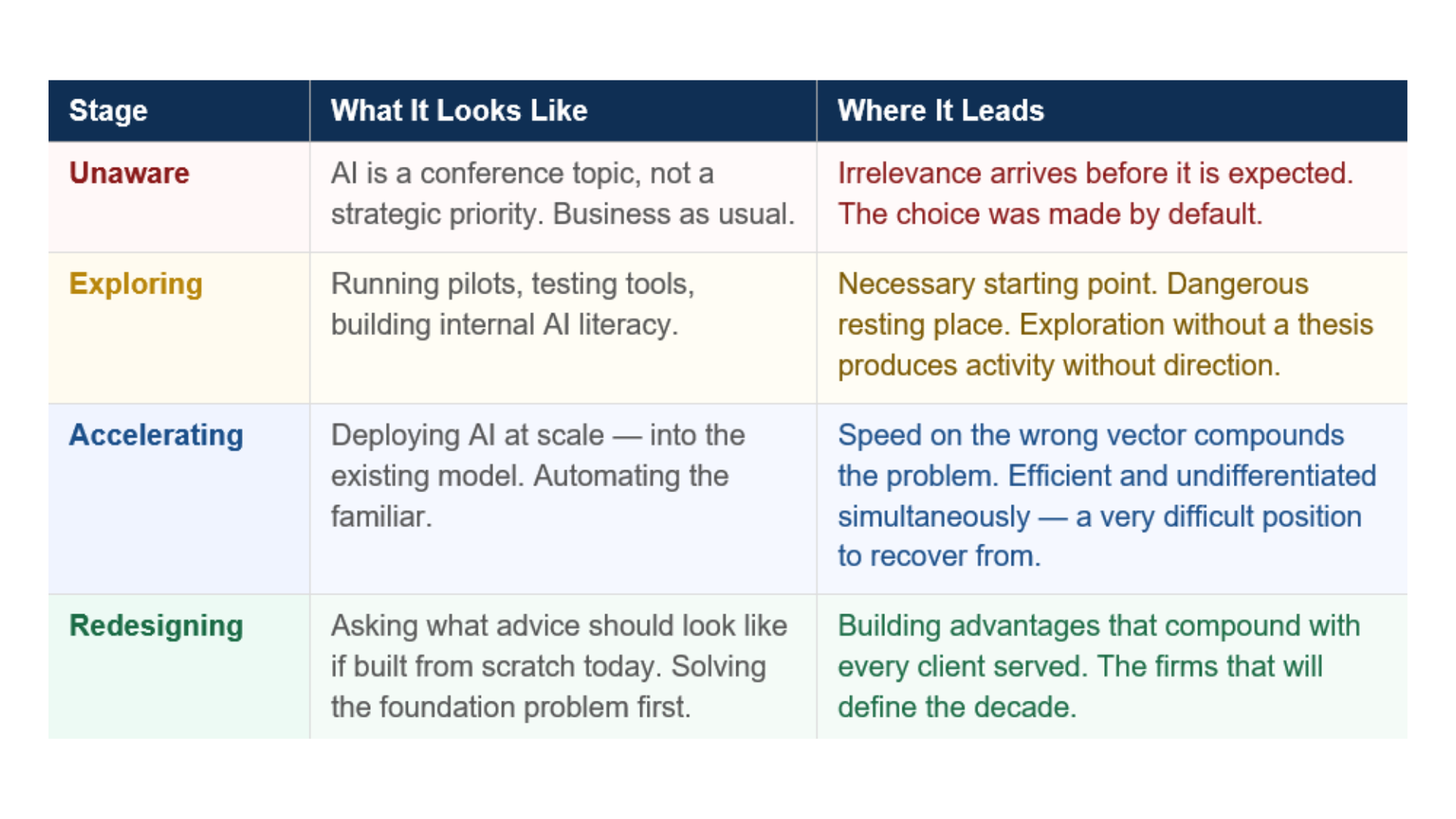
The most dangerous position is not Unaware — those firms will eventually be forced to confront the reality. The most dangerous position is Accelerating: firms that have committed significant capital and organizational energy to deploying AI into the existing model, and will discover only later that they have optimized a business model the market is in the process of making obsolete.
Two Trajectories, One Choice
The strategic choice ultimately resolves to two trajectories — and the architectural decisions being made today determine which one a firm is on.
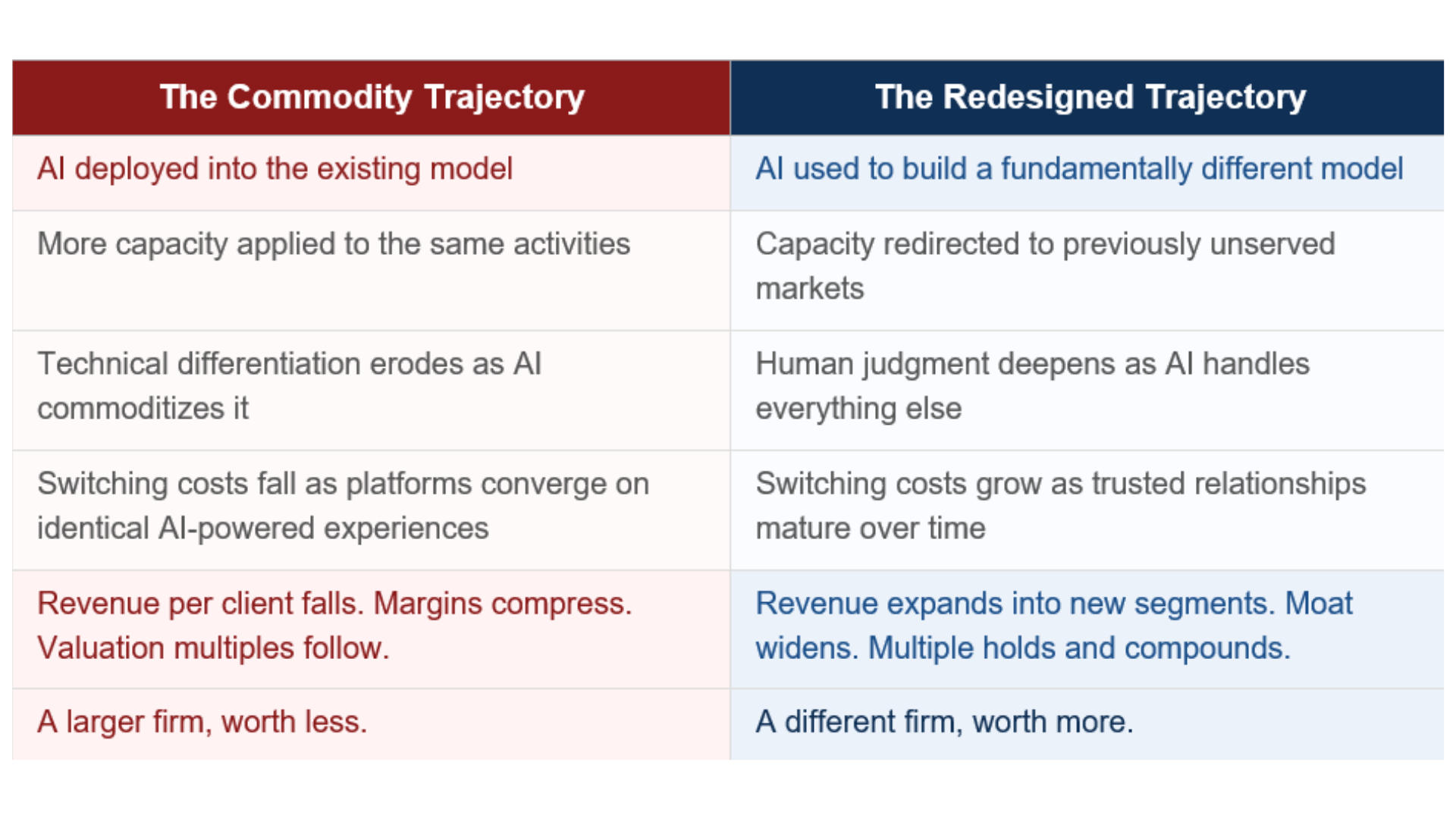
The distinction between these two trajectories is not yet visible in most firms’ financials. It is visible in the architectural choices being made right now — in whether firms are scaling the existing model or redesigning toward a market that the existing infrastructure could never serve.
The firms that will be remembered for this moment are not the ones that adopted AI fastest. They are the ones that understood what AI made possible — and built deliberately toward it while the window was still open.
X. Strategic Implications
The implications of this shift extend across every segment of the wealth management industry, and the strategic responses required differ materially by firm type.
Banks and Incumbents
Large incumbent institutions carry significant advantages in distribution, brand, and existing client relationships — but their legacy technology infrastructure and branch-era economics represent meaningful liabilities. The risk for incumbents is not disruption from a single competitor but gradual erosion as more agile operators begin serving the mass affluent more effectively and profitably. The strategic imperative is platform modernization, and the window for doing so on favourable terms may be narrowing.
Independent Advisors
For independent advisors, AI-enabled platforms represent one of the most significant growth opportunities in a generation. The advisor who embraces an intelligent operating model can expand their client base substantially without degrading service quality — in effect, competing for segments of the market previously inaccessible at their cost structure. The risk is inaction: advisors who defer modernization will find themselves at a structural disadvantage relative to peers who move earlier.
Dealers and Platform Providers
Dealers and platform businesses are positioned to become the infrastructure layer of AI-powered advice at scale. Those that invest in building or acquiring the right capabilities can serve as the operating backbone for thousands of advisors — aggregating scale, driving efficiency, and enabling personalization that individual advisors could not achieve independently. The firms that move decisively here will define the competitive landscape for the next decade.
Regulators
For regulators, AI-enabled advice presents a genuine opportunity to advance access to quality financial guidance without compromising investor protection. The challenge will be ensuring that frameworks governing AI-assisted advice are calibrated appropriately — robust enough to protect consumers, flexible enough to permit the innovation that expanding access requires. Getting this balance right is one of the most consequential policy questions the industry faces.
XI. The New Golden Age of Advice
For most of the history of modern wealth management, quality financial advice has been abundant for the wealthy and scarce for everyone else. That scarcity was not inevitable — it was the product of economic constraints that limited who could be served profitably and how. Those constraints are dissolving.
The operating system Agora has built gives the industry an infrastructure it has never previously had: the capacity to deliver personalized, trusted, human-centered financial guidance at scale to ordinary investors — not as a charitable mission, but as a commercially sound business model. The mass affluent are an underserved market of enormous scale and long-term value, capable of sustaining profitable relationships with firms that build the right capabilities to serve them.
The firms that recognize this opportunity and move to capture it — not by replacing human advisors but by amplifying them, not by reducing service quality but by enabling it at greater scale — will be the defining success stories of the next chapter in wealth management.
The first fintech era made investing digital. The next era will make advice abundant — and Agora is here to lead it.
That outcome represents one of the most exciting opportunities in modern financial services. The end of advice scarcity has arrived. The race to lead it is already underway. The greatest beneficiaries will be the millions of households that the industry long underestimated. The greatest winners will be the firms that recognized their value first — and built the infrastructure to reach them.